Twelve-string guitar
January 29, 2010Twelve-string guitar

The twelve-string guitar is an acoustic or electric guitar with 12 strings in 6 courses, which produces a richer, more ringing tone than a standard six-string guitar. Essentially, it is a type of guitar with a naturalchorus effect due to the subtle differences in the frequencies produced by each of the two strings on each course.
Contents[hide] |
[edit]Design
The strings are placed in courses of two strings each that are usually played together. The two strings in each bass course are normally tuned an octave apart, while each pair of strings in the treble courses are tuned in unison. The tuning of the second string in the third course (G) varies: some players use a unison string while others prefer the distinctive high-pitched, bell-like quality an octave string makes in this position. Some players, either in search of distinctive tone or for ease of playing, will remove some of the doubled strings. For example, removing the higher octave from the three bass courses simplifies playing running bass lines, but keeps the extra treble strings for the full strums.
The strings are generally arranged such that the first string of each pair to be struck on a downward strum is the higher octave string; however, this arrangement was reversed by Rickenbacker on their electric360/12.
The tension placed on the instrument by the strings is great, and because of this, 12 string guitars have a reputation for warping after a few years of use. Some twelve-string guitars have non-traditional structural supports to prevent or postpone such a fate, at the expense of appearance and tone. Until recently, twelve-string guitars were nearly universally tuned lower than the traditional EADGBE, to reduce thestresses on the instrument. Lead Belly may have used a low C-tuning. [1]
Some performers prefer the richness of an open tuning due to its near-orchestral sound. For a very complex plucked-string sound, the 12-string can be set to standard tuning (or possibly an octave lower), then the top one and low two string pairs can be tuned to whole-tone intervals. The usual gamut of guitar tunings are also available. Many performers who play the twelve-string guitar use an ordinary six-string guitar as their primary instrument, switching to the twelve-string guitar for certain songs that seem to call for a brighter sound.
Because it is substantially more difficult to pluck individual strings on the twelve-string guitar, and almost impossible to bend notes tunefully, the instrument is rarely used for lead musical parts. 12-string guitar is however primarily suited to a rhythm or accompaniment role and is often used in folk songs and some popular music. Some hard rock and progressive rock musicians use double-necked guitars, which have both six-string and twelve-string components, allowing the guitarist easy transition between different sounds.
The greater number of strings complicates playing, particularly for the plucking (or picking) hand. The gap between the dual-string courses is usually narrower than that between the single-string courses of a conventional six-string guitar, so more precision is required with pick or fingertip when not simply strumming chords. The pairing of thin, easily broken octave strings with larger, stiffer bass strings presents difficulties to the player also, and only a very skilled player can reliably pluck single strings from within a course at any speed (notably the very high octave G string, which is the highest-pitched string on the instrument). Nevertheless, with practice, the twelve-string guitar is not unduly difficult to play. It is, however, generally used in a fairly restricted role which emphasizes its strengths: rich ringing, full-bodied chords, and fast, rippling single plucked notes on the twinned strings. Twelve-string guitars are made in both acoustic and electric form. However, it is the acoustic type that is most common.
[edit]Chorus effect
The double ranks of strings of the 12-string guitar produce a shimmering chorus effect. To produce this effect individual string sounds with roughly the same timbre and nearly (but never exactly) the same pitch converge and are perceived as one. When the effect is produced successfully, none of the constituent sounds is perceived as being out of tune. Rather, this amalgam of sounds has a rich, shimmering quality which would be absent if the sound came from a single source. The effect is more apparent when listening to sounds that sustain for longer periods of time, such as a long guitar chord.
[edit]Usage
Use of twelve-string electric guitar almost appears to be cyclical: beginning with Blind Willie McTell in the '20s and '30s, Lead Belly in the '40s, and continuing with Bob Gibson in the '50s and early '60s, performers and Gibson acolytes such as Mike Pender of The Searchers and Roger McGuinn of The Byrds, brought it to the fore for a decade, until it fell out of favor and was largely limited to niche use by progressive rockers in the 1970s. The instrument was revived in the 1980s by alternative rockers such as Robert Smith of The Cure, Slash of Guns N' Roses, Dave Gregory of XTC, Peter Buck of R.E.M., Marty Willson-Piper of The Church, and Johnny Marr of The Smiths. During the 1990s, its popularity waned again, although it plays a key part in the sound of indie rock acts such as Low and The Decemberists. The most popular electric twelve-string model since the 1960s has been the Rickenbacker 360/12, first popularized by George Harrison. Many double-neck guitars have a twelve-string neck, in order for guitarists to switch between tones during live performances, for example, when playing Stairway to Heaven,Hotel California or Xanadu.
[edit]Notable performers

Performers who use acoustic 12-string guitars span a range of genres, from folk (Arlo Guthrie, Gordon Lightfoot and Pete Seeger) and traditional blues (Lead Belly) to folk rock (Paul Simon, Neil Young, John Allan Cameron), country (Pinmonkey's Michael Reynolds) and rock bands (Richie Sambora of Bon Jovi, George Harrison [2] of The Beatles, David Bowie for his Space Oddity live performances, Pete Townshend of The Who, Tom Petty and Mike Campbell of Tom Petty and the Heartbreakers, Brian Mayof Queen, and Nick Valensi of The Strokes).[3] Numerous other musicians, includingLeo Kottke, Roger McGuinn of The Byrds, Matt Nathanson and John Butler, use it as their main instrument.
Electric Rickenbacker 12-string users include a range of jangle pop guitarists, ranging from McGuinn to Peter Buck (R.E.M.). The Gibson EDS-1275 electric 12-string was used by blues rock/early heavy metal guitarist Posted by Cheryl Yap.
Lap steel guitar
January 29, 2010Lap steel guitar

| Classification | String instrument (Usually played with a slide and guitar pick.) |
|---|---|
| Related instruments | |
The lap steel guitar is a type of steel guitar, from which other types developed.
There are three main types of lap steel guitar:
- Lap slide guitars, the first developed, which use a similar sound box to a Spanish guitar. These were originally called Hawaiian guitars and included versions that had a factory r...
Continue reading...
Posted by Cheryl Yap.
Steel-string acoustic guitar
January 29, 2010Steel-string acoustic guitar
 An Aria AW series steel-string acoustic guitar | |
| String instrument | |
|---|---|
| Classification | String instrument (plucked) |
| Hornbostel-Sachs classification | 321.322-6 (Composite chordophonesounded by a plectrum) |
| Playing range | |
 | |
| Related instruments | |
| |

A steel-string acoustic guitar is a modern form of guitar ...
Continue reading...
Posted by Cheryl Yap.
Classical guitar
January 29, 2010Classical guitar
 A modern classical guitar from the front and side | |
| String instrument | |
|---|---|
| Hornbostel-Sachs classification | 321.322-5 (Composite chordophonesounded by the bare fingersor fingernails) |
| Developed | modern classical guitar was developed in the late 19th century |
| Playing range | |
| |
| Related instruments | |
| |
| Musicians | |
The classical guitar, also known as the "...
Continue reading...
Posted by Cheryl Yap.
Acoustic Guitar
January 29, 2010Acoustic guitar
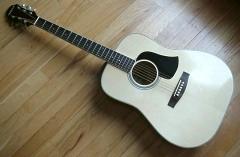 A modern acoustic guitar.
An acoustic guitar is a guitar that uses only acoustic methods to project the sound produced by its strings. The term is a retronym, coined after the advent of electric guitars, which rely on electronic amplification to make their sound audible.
Contents
[hide]
[edit]Sound production
In all types of guitars the sound is produced by the vibration of the strings. However, because the strin...
An acoustic guitar is a guitar that uses only acoustic methods to project the sound produced by its strings. The term is a retronym, coined after the advent of electric guitars, which rely on electronic amplification to make their sound audible.
Contents[hide] |
[edit]Sound production
In all types of guitars the sound is produced by the vibration of the strings. However, because the strin...
Continue reading...
Posted by Cheryl Yap.